Beyond GC-MS: Building a More Complete Quality Control System for Modern E-Liquid Manufacturing
The evolution of e-liquid manufacturing is no longer only about developing new flavors.
Today, global brands are placing increasing attention on a more fundamental question:
How can e-liquid quality be measured, controlled, and consistently reproduced at scale?
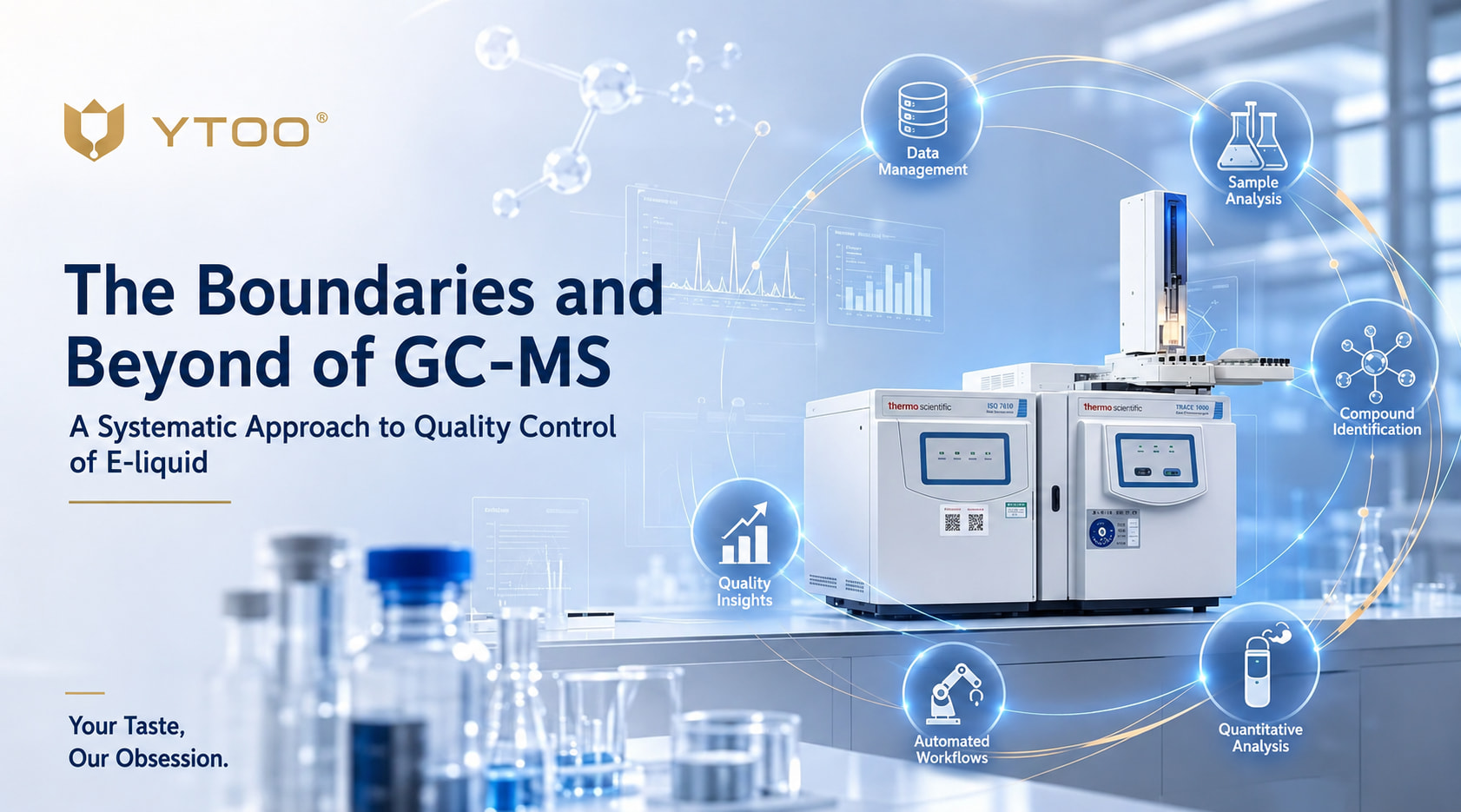
For years, GC-MS (Gas Chromatography-Mass Spectrometry) has been one of the most important analytical technologies in e-liquid research.
It provides valuable insights into volatile compounds, raw material consistency, flavor composition, and formulation changes.
However, as analytical capabilities become more widely available across the industry, a new challenge has emerged:
GC-MS alone is no longer enough to define the complete quality profile of modern e-liquid products.
From Chemical Analysis to Quality Engineering
E-liquid is a complex multi-component system.
The final product performance is influenced by multiple factors, including:
• Flavor composition
• PG/VG carrier system
• Ingredient interactions
• Storage stability
• Manufacturing consistency
• Device compatibility
While GC-MS can provide detailed chemical information, it represents only one part of the product lifecycle.
Modern quality control requires integrating multiple capabilities:
 Advanced analytical testing
 Structured formulation data
 Stability evaluation
 Intelligent manufacturing control
 Device performance validation
Together, these elements create a more complete quality engineering framework.
Data-Driven Flavor Development
In today’s competitive market, formulation experience alone is no longer sufficient.
The accumulation and utilization of formulation data have become increasingly important.
At YTOO, we have developed a structured flavor database containing more than 30,000 formulation records, covering different flavor categories, ingredient combinations, base liquid systems, and device application scenarios.
By combining historical formulation data with scientific development methods such as DOE (Design of Experiments), R&D teams can improve development efficiency while better predicting formulation performance.
The goal is not only to create new flavors.
It is to create flavors that remain stable, reproducible, and adaptable across different applications.
Manufacturing Consistency Matters
A successful formulation must also survive the transition from laboratory development to commercial production.
This is where digital manufacturing systems become critical.
Through MES (Manufacturing Execution System) and process monitoring, manufacturers can improve:
- Batch traceability
- Production consistency
- Process control
- Quality stability
Quality is not created only during final inspection.
It is built throughout the entire manufacturing process.
Bridging the Gap Between Liquid and Aerosol
One of the most important considerations in modern e-liquid development is understanding that consumers do not experience liquid directly.
They experience aerosol.
Different devices, coil structures, resistance levels, and power settings can significantly influence flavor delivery.
Therefore, device compatibility testing has become an essential part of product validation.
A complete quality system must connect:
Formulation → Manufacturing → Device → User Experience
YTOO’s Approach
At YTOO, we believe that future e-liquid quality will be defined by integrated engineering capabilities rather than individual technologies.
By combining:
 Multi-dimensional laboratory analysis
30,000+ formulation database
MES-based manufacturing management
Stability validation
Device compatibility testing
we continue to build a quality framework designed for consistent and scalable e-liquid solutions.
Read the full technical article:
 https://www.ytoojuice.com/gc-ms-e-liquid-quality-control/


 Full article on our website: https://www.ytoojuice.com/earth-day-responsible-manufacturing/
 May 8–10, 2026
 NEC Birmingham – Booth S7
 Blueberry Cheesecake – Fresh blueberry tartness, creamy cheesecake, buttery biscuit crust.
 Berry Cheesecake – Blueberry, raspberry, strawberry layered with creamy cheese.
 Taro Cheesecake – Taro sweetness blended with smooth cheesecake – a local favourite.
 White Chocolate – Pure milky cocoa butter, clean vanilla finish.
 Lemon Tart – Bright lemon curd, buttery baked crust, refreshing.
 Jasmine Tea – Floral jasmine with green tea astringency, no sweetness.
 Coconut Ice – Clear coconut water, natural sweetness, cooling finish.
 Taro Ice Cream – Lighter than cheesecake, creamy ice cream with taro.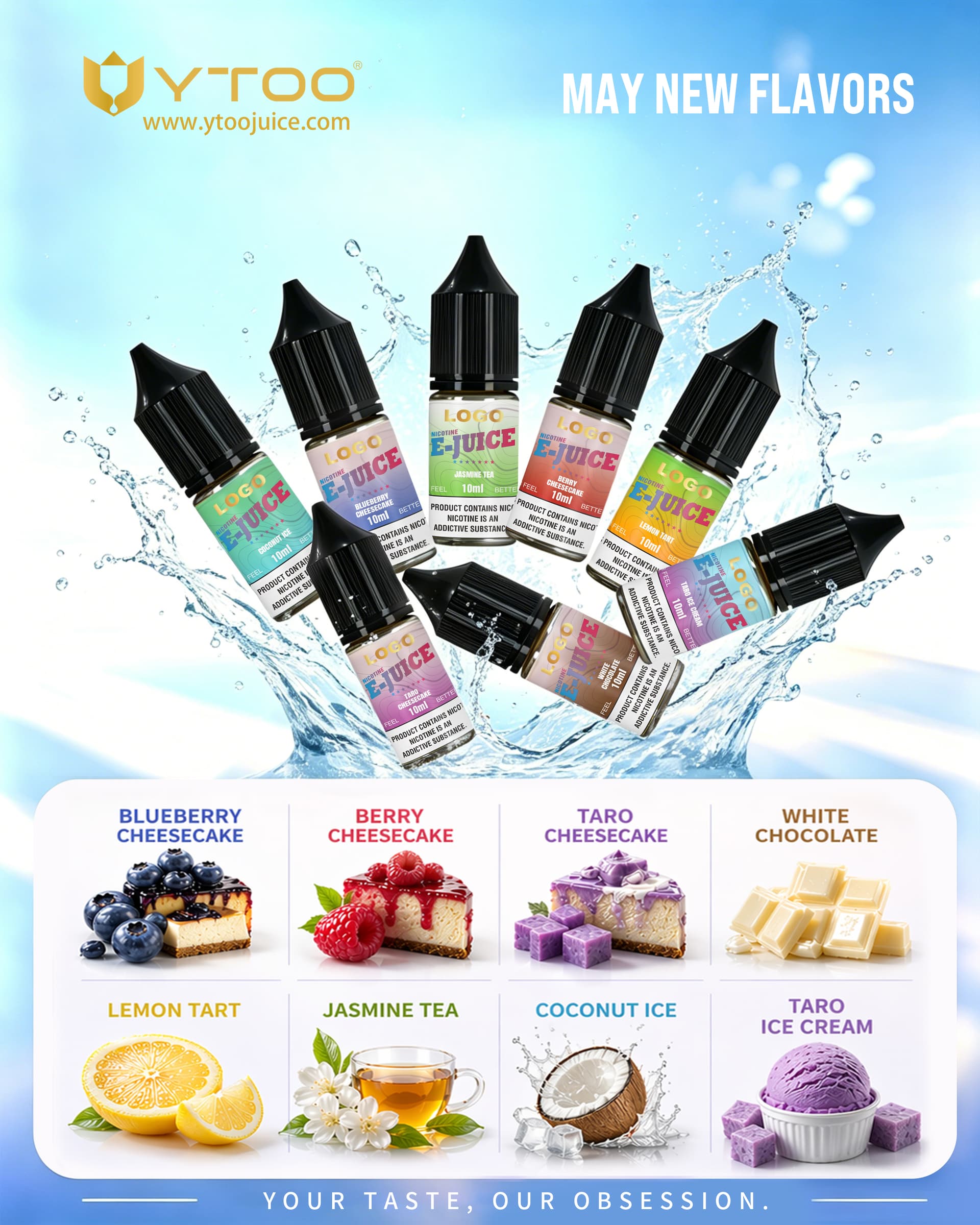




 USA
USA UK
UK South Korea
 /
/  Middle East
 Southeast Asia (general)